 Mantle staked
 ETH becomes mETH, with distinct on-chain states for deposit, redemption request and claim
Mantle staked ETH starts with a deposit to mETH Protocol on Ethereum. A successful transaction changes the wallet’s state from ETH to mETH at the quoted exchange rate. The wallet balance and transaction receipt show that staking completed. Redeeming follows a different sequence: mETH enters an unstake request, the request waits until it becomes claimable and a claim transaction returns the corresponding ETH.
Bottom line: Depositing ETH mints mETH at the active exchange rate, while redemption follows a separate request, queue and claim process.
The asset in your wallet narrows the valid routes
The valid action depends on whether the wallet holds ETH, mETH or a pending unstake request. The available transactions and their completion checks differ by state and by goal.
ETH on Ethereum can enter the protocol’s staking contract. The contract calculates an output from the active ETH-to-mETH exchange rate and mints mETH to the address that submits the stake. This pooled route doesn’t create a personal validator or require the depositor to operate validator software.
A wallet that already holds mETH has an open liquid staking position. Transferring the token changes who holds the position, while using it in a compatible application can add separate contract and liquidity exposure. Neither action creates a native unstake request.
A pending request has locked the submitted mETH for protocol redemption. The committed mETH is no longer an ordinary spendable balance, yet claimable ETH may not be available immediately. If the goal is faster liquidity, a secondary-market sale is a separate route whose price and execution depend on that market.
The exchange rate links mETH to pooled ETH
mETH is a value-accumulating ERC-20 receipt token for ETH deposited through mETH Protocol. Its balance represents units of the pooled position, while the protocol’s conversion rate expresses how much ETH those units represent. Accrued validator returns enter protocol accounting after applicable fees rather than arriving as a separate reward token in the holder’s wallet.
The protocol combines validator principal and returns with liquidity reserved for redemptions. Oracle records update the accounting used by the staking contract, subject to validation and sanity checks. A wallet balance alone therefore gives an incomplete reading: the current exchange rate is also needed to estimate the position’s ETH value or a prospective redemption amount.
A valid deposit starts with four inputs
A deposit needs the correct input asset, network, live quote and enough ETH for transaction gas. These inputs should be settled before signature because a mined transaction can’t repair an incorrect network or recipient.
The deposit check covers the asset, network, quote and gas
Asset and network
The direct staking vault operates on Ethereum L1 and accepts ETH. Holding another asset, or holding ETH on another network, doesn’t satisfy that input. Moving assets between networks is a separate transaction with its own confirmation state and risks.
Quote and wallet capacity
The displayed output should use the active exchange rate and any adjustment applied by the protocol. If the transaction includes a minimum mETH output, that value defines the acceptance boundary. The wallet also needs additional ETH for gas, so staking its entire displayed balance can leave the transaction unfunded.
- Confirm that the transaction uses Ethereum and spends ETH.
- Read the quoted mETH output rather than assuming a one-to-one amount.
- Check any minimum output before signing.
- Keep enough ETH available for network gas.
The receipt and mETH mint prove settlement
Submitting a transaction doesn’t prove completion. Completion requires a successful receipt and the corresponding mETH mint to the address that submitted the stake. A failed receipt means the stake didn’t change protocol state, although Ethereum may still charge gas for the attempted transaction.
A hypothetical 1.38 ETH deposit tests a 1.25 mETH minimum
Every number in this example is hypothetical and none describes a live quote. Assume a wallet on Ethereum holds more than 1.38 ETH, plans to stake 1.38 ETH and sees a net quote of 0.918 mETH per ETH. The displayed minimum received is a hypothetical 1.25 mETH, while gas remains separate and variable.
Multiplying 1.38 by 0.918 gives an estimated 1.26684 mETH. That estimate exceeds the 1.25 mETH acceptance condition, so the quoted output clears the displayed minimum. If the transaction enforces that minimum, execution below 1.25 mETH will revert.
If the transaction enforces that minimum, the independent checks after settlement are a successful Ethereum receipt and an mETH increase of at least 1.25 mETH for the address that submitted the stake. If the receipt remains pending, the reader waits rather than submitting the same action again. If it fails, the ETH-to-mETH transition didn’t complete and the wallet can inspect the failure before preparing another transaction.
Position checks don’t require another transaction
Monitoring an mETH position doesn’t require another transaction. The token balance identifies the units held, and the live conversion rate estimates their ETH value. The network matters because the same wallet address can display different balances on Ethereum and Mantle. Check allowances and application deposits separately. mETH supplied to another contract may no longer appear in the wallet, and the receiving application determines whether and how the address retains a claim.
A redemption request isn’t the same as a claim
Native redemption begins when the holder submits mETH for unstaking. The protocol records the request in a first-in, first-out queue and assigns the corresponding ETH amount. That transaction establishes a pending claim rather than delivering spendable ETH.
The protocol fixes the ETH conversion rate when an unstake request is submitted, so the queued mETH doesn’t accrue later staking rewards. Waiting longer to claim therefore doesn’t increase that request through subsequent changes in the mETH exchange rate.
Liquidity can come from ETH held for redemptions or from validator principal returning through Ethereum’s withdrawal process. Available buffer liquidity and the validator exit queue can both affect timing. An interface estimate depends on current conditions, so it isn’t a fixed deadline.
Once the request becomes claimable, the holder still needs the claim transaction required by the contract. Queue eligibility is an intermediate state. Completion appears when that claim succeeds and the recipient’s ETH balance reflects the payment.
Costs and risks attach to different stages
Protocol accounting and network costs
Staking returns reach mETH after the protocol accounts for its reward fee. A deposit quote may also reflect the active adjustment rate. Those deductions differ from Ethereum gas, which the wallet pays when it submits deposit, unstake and claim transactions. A zero protocol fee displayed for unstaking therefore wouldn’t make the full route costless.
Validator, contract and liquidity exposure
The pooled position remains exposed to Ethereum validator rewards and penalties. Smart contract behavior, oracle reporting and protocol controls add another layer of risk. Redemption liquidity also depends partly on assets managed outside the validator set, so the buffer’s availability can’t guarantee immediate settlement for every request.
Using mETH elsewhere adds the risks of the receiving application, including liquidation or liquidity-pool loss where those mechanisms apply. Market price can also move away from the protocol’s redemption value. A sale may settle sooner than native redemption, but the execution price can include slippage or a discount.
Restaking is a separate opt-in state. Converting mETH into cmETH adds exposure to third-party restaking systems and potential penalties associated with those systems. Simply holding mETH doesn’t add that restaking layer.
The exit method determines the completion evidence
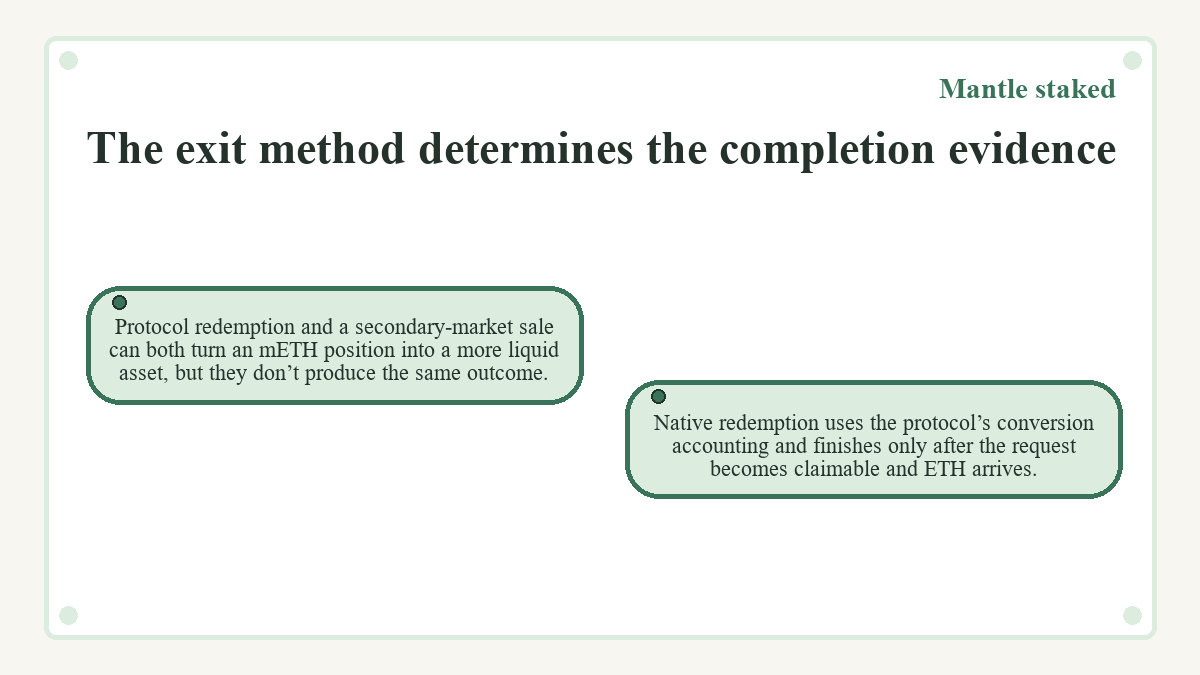
Protocol redemption and a secondary-market sale can both turn an mETH position into a more liquid asset, but they don’t produce the same outcome. Native redemption uses the protocol’s conversion accounting and finishes only after the request becomes claimable and ETH arrives.
A market sale transfers mETH to a buyer or trading contract at the available market price. Its completion evidence is the settled trade and the asset received, not an entry in the protocol’s unstake queue. Price impact, venue liquidity and transaction costs can make the proceeds differ from native redemption value.
Sending mETH to another wallet doesn’t redeem the position. It transfers the liquid staking position, including its exposure to later exchange-rate changes. For a native exit, the decisive figure is the claimable ETH amount recorded for the unstake request.
Mantle staked questions worth asking
Do I need 32 ETH to receive mETH?
No, receiving mETH through the pooled protocol doesn’t require you to fund or operate an individual 32 ETH validator. You deposit the amount accepted by the staking interface and receive mETH at the active conversion rate. The wallet must also retain enough ETH to pay Ethereum transaction gas.
Does mETH add staking rewards by rebasing my wallet balance?
No, mETH represents accrued value through its ETH conversion rate rather than routinely increasing every holder’s token count. Without transfers, deposits or withdrawals, the displayed mETH balance can stay unchanged while its corresponding ETH value changes. A wallet or portfolio view needs the current conversion rate to show that relationship.
Can mETH move between Ethereum and Mantle?
Yes, mETH exists on Ethereum and Mantle, but moving it between those networks requires a supported bridge transaction. Changing the selected network in a wallet doesn’t move the token. The transfer is complete only after the destination network records the bridged balance, and bridge settlement is separate from staking or redemption.
Why might a successful stake not appear in my wallet immediately?
A successful receipt may mint mETH correctly even when the wallet hasn’t added the token to its visible asset list. Check the transaction’s network and submitting address, then inspect the receipt for the mETH mint. A pending or failed receipt doesn’t prove that any mETH was minted.
Is cmETH the same asset as mETH?
No, cmETH is a separate receipt token for mETH placed into a restaking portfolio. It inherits the underlying mETH exposure and adds the risks and potential rewards of third-party restaking systems. Moving from mETH to cmETH is an opt-in state change, not an automatic part of ordinary ETH liquid staking.
- last updated